Contents
Federal Energy Tax Credit for Windows in 2026: How to Qualify and Claim
Get up to $600 back on your window replacement with the federal Energy Efficient Home Improvement Credit. Step-by-step guide to qualifying for and claiming the 2026 federal energy tax credit for windows.
CozyBetterHomes Team
40+ combined years in window and door replacement
What is the federal tax credit for energy-efficient windows in 2026?
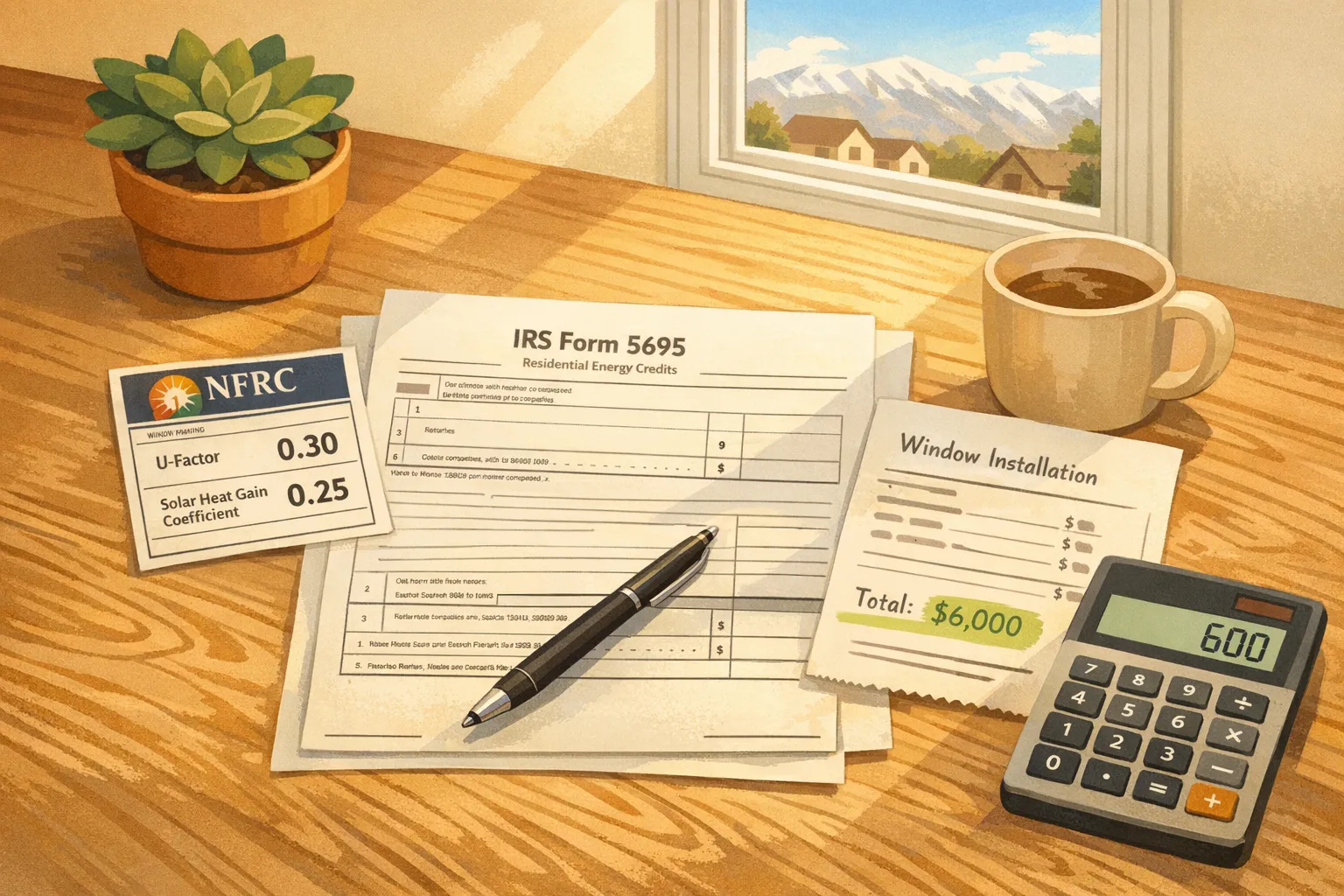
The federal Energy Efficient Home Improvement Credit covers 30% of window replacement costs, up to $600 per year, through 2032. Windows must be Energy Star certified for Climate Zone 5 (U-factor 0.25 or lower) to qualify in Utah. The credit is nonrefundable and claimed on IRS Form 5695 Part II, then transferred to Form 1040 Schedule 3.
- •30% of window costs up to $600 annual cap
- •Requires Energy Star certification with U-factor 0.25 or lower for Utah
- •Claimed on IRS Form 5695 regardless of standard vs itemized deduction
- •Split large projects across two tax years for up to $1,200 total
Note: Your federal tax liability (credit is nonrefundable) and whether windows meet Energy Star Climate Zone 5 requirements
Quick Hits
- •The federal Energy Efficient Home Improvement Credit covers 30% of window costs, up to $600 per year through 2032.
- •Windows must be Energy Star certified for Climate Zone 5 (U-factor 0.25 or lower) to qualify in Utah.
- •The credit is nonrefundable, meaning it reduces your tax bill but cannot generate a refund beyond what you owe.
- •Claim the credit on IRS Form 5695 Part II, then transfer to Form 1040 Schedule 3.
- •Split large projects across two calendar years to potentially claim $1,200 in total credits.
If you are replacing windows in 2026, the federal government will help you pay for them. The Energy Efficient Home Improvement Credit, part of the Inflation Reduction Act, lets you claim 30% of your window replacement costs as a dollar-for-dollar tax credit. For most Utah homeowners, that means up to $600 back on your tax return.
This guide explains exactly what qualifies, how to claim the credit, and how to avoid the common mistakes that cause homeowners to miss out. For a broader view of all available incentives including utility rebates and manufacturer promotions, see our complete Utah rebates and tax credits guide.
What Is the Energy Efficient Home Improvement Credit
The Energy Efficient Home Improvement Credit (formerly known as the 25C credit) was significantly expanded by the Inflation Reduction Act of 2022. Starting in 2023 and running through 2032, this credit provides a direct dollar-for-dollar reduction in your federal tax liability when you install qualifying energy-efficient improvements in your home.
For windows specifically:
- Credit rate: 30% of the total cost (materials plus installation labor)
- Annual cap for windows and skylights: $600
- Annual cap for exterior doors: $250 per door, $500 total
- Overall annual cap: $3,200 across all qualifying improvement categories
- Available through: December 31, 2032
- Credit type: Nonrefundable (reduces your tax liability but does not generate a refund)
The credit resets each tax year, which is a crucial detail for project planning. If you replace windows in both 2026 and 2027, you can claim up to $600 each year.
Windows, Doors, and Skylights: What Qualifies
The credit covers several categories of fenestration products, each with its own cap:
Windows and Skylights ($600 Annual Cap)
Any exterior window or skylight that meets Energy Star certification requirements for your climate zone qualifies. This includes:
- Double-hung windows
- Casement windows
- Sliding windows
- Picture and fixed windows
- Awning windows
- Bay and bow windows
- Skylights and roof windows
The credit covers the full installed cost: the window unit itself, hardware, installation labor, and any necessary modifications to the existing opening.
Exterior Doors ($250 per Door, $500 Total)
Energy Star certified exterior doors also qualify under a separate cap. This includes entry doors, patio doors, and sliding glass doors. If you are already replacing windows, adding a door or two to your project is an easy way to capture an additional $250 to $500 in credits.
What Does NOT Qualify
- Windows in new construction (the home must already exist)
- Windows in rental properties, vacation homes, or second residences
- Storm windows installed over existing windows (only full replacement qualifies)
- Interior doors or windows
- Windows that do not meet Energy Star requirements for your zone
Energy Star Requirements for Utah Climate Zone 5
Utah's populated areas, including Salt Lake City, Provo, Ogden, Park City, and St. George, fall primarily in Climate Zone 5. To earn Energy Star certification in Zone 5, windows must meet these minimum performance standards:
| Rating | Requirement | What It Measures |
|---|---|---|
| U-factor | 0.25 or lower | Rate of heat transfer (lower is better) |
| SHGC | 0.40 or lower | Solar heat gain (lower means less summer heat) |
| Air leakage | 0.30 cfm/ft or lower | Draft prevention (lower is tighter) |
These ratings are printed on the NFRC (National Fenestration Rating Council) label affixed to every new window. The label is typically a black-and-white sticker on the glass or frame.
Most modern vinyl and fiberglass windows from reputable manufacturers comfortably meet these thresholds. Budget or entry-level windows sometimes fall short, particularly on U-factor. Always verify before purchasing. Our Energy Star windows guide covers specific brands and models that qualify.
Going Beyond the Minimum
While a U-factor of 0.25 is sufficient for the federal tax credit, upgrading to 0.22 or lower also qualifies you for the highest tier of Rocky Mountain Power utility rebates, adding another layer of savings on top of the federal credit.
How Much You Can Claim
The math is straightforward. Multiply your qualifying window costs by 30%, and cap the result at $600.
Example 1: Small project
- 5 windows at $400 each = $2,000 total cost
- 30% of $2,000 = $600
- Credit claimed: $600 (hits the cap)
Example 2: Modest project
- 3 windows at $500 each = $1,500 total cost
- 30% of $1,500 = $450
- Credit claimed: $450 (under the cap, so you get the full 30%)
Example 3: Large project, single year
- 15 windows at $450 each = $6,750 total cost
- 30% of $6,750 = $2,025
- Credit claimed: $600 (capped)
Example 4: Large project, split across two years
- Year 1: 8 windows at $450 each = $3,600 (30% = $1,080, capped at $600)
- Year 2: 7 windows at $450 each = $3,150 (30% = $945, capped at $600)
- Total credit claimed: $1,200
The split-year strategy essentially doubles your federal savings on any project costing more than $2,000 total.
Step-by-Step: How to File for the Credit
Filing for the window tax credit is not complicated, but you need to follow the correct forms. Here is the exact process:
Step 1: Gather Your Documentation
Before sitting down to file, collect:
- Receipts or invoices showing the total cost of windows and installation
- Manufacturer's certification statement: This is a written statement from the window manufacturer (not the contractor) confirming the product meets Energy Star requirements. Most manufacturers provide this on their website or include it with the product packaging. It is different from the NFRC label.
- NFRC labels: Photograph these before they are removed or obscured
Step 2: Complete IRS Form 5695, Part II
Form 5695 is titled "Residential Energy Credits." Part II covers the Energy Efficient Home Improvement Credit (Part I covers solar and geothermal, which are different programs).
On the form:
- Line 12a: Enter the total cost of qualifying windows and skylights
- Line 12b: The form calculates 30% of line 12a
- Line 12c: Enter $600 (the statutory maximum for windows)
- Line 12d: The smaller of 12b and 12c is your windows credit
If you also installed qualifying doors, there are separate lines for those.
Step 3: Calculate Your Total Credit
The form walks you through combining window credits, door credits, and any other qualifying improvement credits into a single total.
Step 4: Transfer to Form 1040
The total credit from Form 5695 transfers to Form 1040, Schedule 3, Line 5 (Residential energy credit). This reduces your total tax liability.
Step 5: File and Retain Records
File Form 5695 with your tax return. Keep all supporting documentation, including receipts, the manufacturer's certification statement, and NFRC label photos, for at least three years after filing. The IRS can audit returns within this window.
If you use a tax preparer or software like TurboTax or H&R Block, the program will walk you through these fields. Just have your documentation ready and know your total window cost.
Documentation You Need to Keep
The IRS may ask for proof that your windows qualify. Keep these items organized and accessible:
-
Manufacturer's certification statement: This is the single most important document. It is a written statement (sometimes called a "tax credit certification") from the manufacturer confirming the product meets Section 25C requirements. Most major manufacturers publish these on their websites.
-
Receipts and invoices: Your contractor's invoice should itemize window costs separately from any non-qualifying work. If your project includes both qualifying windows and non-qualifying items (like interior trim work), make sure the invoice breaks out the qualifying costs clearly.
-
NFRC label photos: Photograph every NFRC label before installation covers them. These labels show the exact U-factor and SHGC ratings that prove Energy Star compliance.
-
Proof of primary residence: The credit only applies to your main home. Keep a utility bill or other document confirming the installation address is your primary residence.
-
Installation completion date: If you are using the two-year split strategy, document exactly which windows were installed in which calendar year.
Two-Year Strategy for Larger Projects
Since the $600 cap resets each January 1, homeowners with projects exceeding approximately $2,000 in total window costs benefit from splitting the work across two calendar years.
How to Execute the Split
- Plan with your contractor: Discuss the split during the quoting phase. Most experienced Utah contractors are familiar with this approach.
- Schedule installation: Complete the first batch by mid-December. Schedule the second batch for January or later.
- Separate invoices: Request separate invoices for each calendar year's installation, clearly dated.
- Pay in each year: The credit is based on when the improvement is "placed in service" (installed), but having payments in the correct year strengthens your documentation.
When It Makes Sense
The two-year split is worthwhile when your project costs exceed $2,000 (since 30% of $2,000 is $600, the annual cap). For a $6,000 project, splitting saves an additional $600. For a $10,000 project, the math is the same because both halves exceed the cap threshold independently.
The split adds minimal inconvenience. Your home may have a mix of old and new windows for a few weeks, and you will have two separate contracts, but the additional $600 in savings is substantial.
Common Questions and Edge Cases
Can I claim the credit for windows I install myself?
Yes, but only the cost of the windows themselves. If you purchase qualifying windows and install them yourself, you can claim 30% of the materials cost. You cannot claim a value for your own labor.
What if I financed the windows?
Financing does not affect the credit. Whether you paid cash, used a home equity loan, or used contractor financing, the credit is based on the total installed cost. However, you claim the credit in the year the installation is completed, not the year you finish paying off the loan.
What about windows I replaced in 2025?
If you installed qualifying windows in 2025, you can claim the credit on your 2025 tax return (filed in early 2026). The credit is available for any installation completed between January 1, 2023, and December 31, 2032.
My contractor says the windows are "energy efficient." Is that enough?
No. "Energy efficient" is a marketing term with no legal standard. Your windows must specifically carry Energy Star certification for your climate zone, backed by NFRC-rated performance data. Always verify the U-factor and SHGC ratings on the NFRC label rather than relying on marketing claims.
Can I combine this with other credits?
Absolutely. The Energy Efficient Home Improvement Credit stacks with utility rebates from Rocky Mountain Power, manufacturer promotions, and contractor discounts. These are all separate programs with no interaction. See our stacking guide for the full strategy.
Taking advantage of the federal tax credit is one of the most straightforward ways to reduce the cost of window replacement in Utah. With proper documentation and a few minutes of additional effort at tax time, you put $600 (or $1,200 with the split strategy) back in your pocket.
Evidence & Sources
Verified 2026-02-10- The credit covers 30% of window costs up to $600 per year through 2032
- IRS - Energy Efficient Home Improvement Credit (2026)
- Energy Star certification for Climate Zone 5 requires U-factor of 0.25 or lower
- Energy Star - Federal Tax Credits for Windows & Skylights (2026)
- NFRC provides standardized window energy performance ratings
- National Fenestration Rating Council (2026)
References
- https://www.irs.gov/credits-deductions/energy-efficient-home-improvement-credit
- https://www.energystar.gov/about/federal-tax-credits/windows-skylights
- https://www.nfrc.org/energy-performance-label/
- https://www.energy.gov/policy/articles/making-our-homes-more-efficient-clean-energy-tax-credits-consumers
- https://basc.pnnl.gov/resource-guides/climate-zone-5
Free Utah Window Replacement Guide
Get our complete guide with local pricing data, rebate info, and a step-by-step replacement timeline — delivered to your inbox.
FAQ
Is the window tax credit a deduction or a credit?
It is a tax credit, not a deduction. A credit directly reduces your tax bill dollar for dollar. If you owe $2,000 in federal taxes and claim a $600 window credit, you now owe $1,400. A deduction only reduces your taxable income, which would save you far less. The Energy Efficient Home Improvement Credit is one of the more valuable tax benefits available for home improvements.
Can I claim the window tax credit if I take the standard deduction?
Yes. The Energy Efficient Home Improvement Credit is independent of whether you itemize deductions or take the standard deduction. You claim it on Form 5695 regardless of your deduction choice. This makes it accessible to the vast majority of taxpayers.
What if my tax bill is less than $600?
Because this is a nonrefundable credit, you can only reduce your tax liability to zero. If you owe $400 in federal taxes, you receive a $400 credit and the remaining $200 is lost. It cannot be carried forward to future tax years. If this applies to you, consider splitting your project across two years or combining it with other tax planning strategies to ensure you can use the full credit.
Do replacement windows in a rental property qualify?
No. The Energy Efficient Home Improvement Credit applies only to your primary residence. Rental properties, vacation homes, and second homes are excluded. However, window replacement in rental properties may be deductible as a business expense or depreciable capital improvement under different tax rules.
Key Takeaway
The 2026 federal Energy Efficient Home Improvement Credit lets Utah homeowners claim 30% of their window replacement costs, up to $600 per year. Qualifying requires Energy Star certified windows with a U-factor of 0.25 or lower, and you claim it on IRS Form 5695 regardless of whether you itemize deductions.